

“A system is never the sum of its parts; it’s the product of their interaction.”
— Russell Ackoff, on Systems Thinking and Management
Your coaching business has a lot of moving parts. Can you see how these parts work together?
Picture this: an article brings someone to your website. They inquire. You respond, have a conversation, and perhaps take them on as a client. Meanwhile, you prepare sessions, send invoices, and try to stay visible to future clients. When each process feels separate, you spend your days dealing with the next urgent thing.
I’ve felt that confusion in my own work. Seeing the whole business first, then the smaller systems within it, helped me understand where each process belongs. It gave me a clearer way to decide what deserves attention.
By the end of this exercise, you’ll have a one-page view of your coaching business. You’ll see how the parts connect, where a valuable process causes friction, and what to improve first. The reward is clarity you can act on.
See the whole coaching business first
Before you examine a single process, look at the whole practice. What work has to happen to bring in clients, serve them well, and keep the business sound?
Ross Harkness, creator of MasteryOS, groups a business into four functions: marketing, sales, operations, and finance. Read his explanation of the model.
| Function | What it must do in a coaching practice | Processes you might place inside it |
|---|---|---|
| Marketing | Help the right people find and understand your work | Positioning, content, referrals, website |
| Sales | Help a suitable prospect decide whether to work with you | Inquiry review, follow-up, assessment, proposal |
| Operations | Deliver the coaching experience you promised | Onboarding, sessions, client communication, progress review |
| Finance | Keep the practice financially sound | Pricing, invoicing, cash tracking, profitability review |
Think of the hierarchy this way: the business contains these functions. Each function contains processes. Each process contains tasks. Replying to an inquiry is a task in the follow-up process. That process belongs in sales, but its success also depends on what marketing passes to it.
You now have a place for work that previously felt scattered. The next question is how the parts pass work to one another.
Follow one client journey across the map
Imagine the client journey for an executive coach who helps first-time CEOs.
A newly appointed CEO hears the coach’s name from a colleague and visits the website. The content makes the coach’s specialty clear, so the CEO sends an inquiry. Someone reviews it, responds, and arranges a conversation. If they agree to work together, onboarding begins. Finance sends the invoice and tracks payment alongside the client work.
The journey crosses processes in all four functions:
- Marketing, through the website content process, helps produce an inquiry from someone who understands the offer.
- Sales takes that inquiry through follow-up and a decision, then passes the agreed scope to operations if the prospect becomes a client.
- Operations welcomes the client through onboarding and delivers the coaching.
- Finance handles invoicing and payment across the engagement, sometimes in parallel with the other functions.
The arrows between processes matter. They show where information or responsibility changes hands. Does the person handling follow-up have enough context to respond well? Does the person handling enrollment pass the client’s goals to the person handling onboarding? Does invoicing begin when agreed? If someone must collect the same information twice, the map shows a handoff to examine.
At TOMC, I use four phases to improve parts of this path. Position clarifies whom the coach helps and why. Presence makes that position visible on the website. Pipeline helps track and follow up with prospects. Performance gives repeat work clear standards, owners, and useful automation. These phases guide improvements across the four business functions.
That is the big picture: what the practice does, how work moves, and where TOMC’s phases can strengthen it. Now we can look inside one process.
Zoom into one process
Suppose the coach’s website attracts visitors and some send inquiries, but few become clients. Where is the trouble: on the website, in follow-up, or at the handoff between them? Start by examining each process separately.
Harkness describes a system through input, process, output, and feedback loop. Applied to the website:
| Part | Website example |
|---|---|
| Input | A visitor arrives with a leadership problem. |
| Process | The content helps the visitor recognize their situation, understand the coach’s approach, see proof, and choose a next step. |
| Output | A relevant inquiry or another deliberate action. |
| Feedback | Inquiry quality, questions prospects ask, and points where visitors leave. |
“The website looks professional” is an impression. “Leaders facing CEO transitions send relevant inquiries” is a result you can examine.
If prospects arrive at a discovery call unsure whom the coach helps, the website message may need work. If suitable prospects understand the offer and inquire but rarely take the next step, look at sales follow-up. These signals tell you where to investigate. They do not prove the cause on their own.
The four-part model lets you inspect any process, from lead follow-up to client onboarding. You can see what enters, what happens, what comes out, and what feedback might help you improve it.
Choose the first process to improve
Your map may reveal several problems. You do not have to fix them all at once.
Layla Pomper of ProcessDriven recommends starting with an area that already creates value but feels painful or difficult, then choosing a recurring activity inside it. Read her guide to small business systems.
Perhaps referrals bring excellent prospects, but responding, collecting background, and arranging the next step consume too much time. Referral follow-up is valuable, recurring, and full of friction. Ask:
- Does this process regularly help produce a result I care about?
- Where does it slow down, depend on my memory, or lead to a lost opportunity?
- Would a clearer process improve the prospect’s experience or free meaningful time?
Circle one process on your map. For referral follow-up, the input is an inquiry from a referred leader. The desired output is a timely, informed response that moves a suitable person to the next step. You have turned a vague sense of busyness into one clear place to work.
Give that process an owner and a standard
Who notices when referral follow-up slips? Name one person accountable for the process and its result. If you work alone, that person is you for now. If someone else handles it, they need to know what good work looks like, what they can decide, and when to involve you.
The person doing the work often sees gaps the founder misses. Ask the owner to draft the standard operating procedure (SOP), or review the version you wrote. It should say what starts the process, which steps to follow, what result to produce, and what to do when a case needs judgment.
For referral follow-up, the owner can check whether suitable inquiries get useful responses and revise the SOP when a step fails. Automation may handle routine steps. A person remains responsible for the result. The process improves as its owner runs it and learns from feedback.
Make your first one-page map
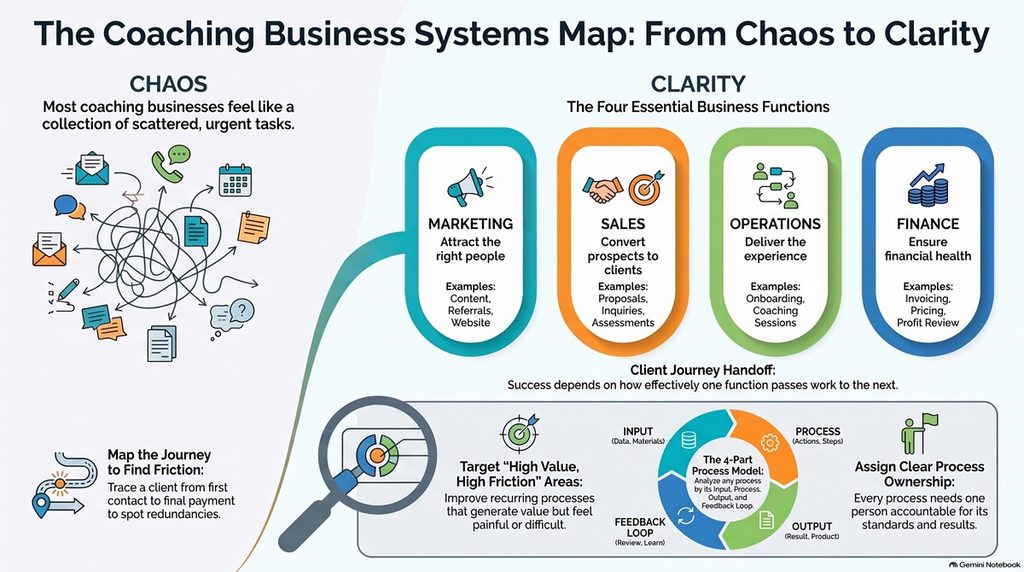
Draw the four functions. Put your main processes under each. Trace one client journey across them, from first contact to coaching and payment. Draw an arrow at every handoff. Then circle one valuable process that causes friction and write down its input, steps, output, feedback, and owner.
That page gives you the clarity this exercise promised. You can see where each process fits, how it connects to the next, and which change deserves your attention. Improve the circled process, then check whether the result gets better. Your next decision has a place in the whole practice.
TOMC’s Growth Assessment looks at Position, Presence, Pipeline, and Performance to find a sensible place to begin improving that system. If you want another set of eyes on your coaching business map, that is where we can start.
